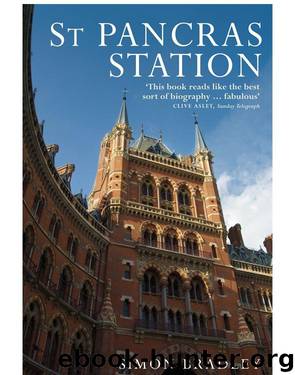
St Pancras Station by Simon Bradley
Author:Simon Bradley
Language: eng
Format: epub
Publisher: Profile Books Ltd
Published: 2008-12-08T16:00:00+00:00
19. The beautiful station at Newcastle upon Tyne, where the arched iron-framed roof was born in 1849—50. The system of parallel spans was taken up at other stations built on a curve, such as York, where a single giant span would not have been practicable.
On a practical level the division of design was no drawback as long as the two parts functioned well together. Recent re-examination of the sources has shown the care with which this boundary was drawn at St Pancras: Barlow worked out the routes by which road vehicles and passengers would enter and leave the station and shaped the hotel’s foundation plan to suit; Scott developed the main emphases of his building around these fixed points and alignments. The different materials and structural systems used by the two men therefore camouflage their deeper interdependence.
Besides, even if the idea of a single designer had prevailed at St Pancras, by the late 1860s there were no longer Brunels or Dobsons available to do the work. Scott and his office no more had the expertise to design a structure as novel and audacious as the St Pancras train shed than Barlow could have come up with a luxurious hotel expressed in advanced and coherent Neo-Gothic. The future belonged to specialisation: a separate Institution of Mechanical Engineers had existed since 1847 (dominated at first, significantly, by locomotive designers); the electrical and telegraph engineers went their own way in 1871, leaving the Institution of Civil Engineers to concentrate on construction. The division of design on the buildings side was never absolute: smaller stations remained part of the railway company engineer’s everyday responsibilities well into the twentieth century (sometimes reworking a basic model supplied by an architect), while any architect of ambition needed to keep up with new materials and construction techniques coming from the engineering side.
The abandonment of the styles of the past in the twentieth century changed the terms on which architects depended on engineers to make their projects work, but left the creative tension between them unresolved.
PAYING THE HOTEL BILL
Architecture is often discussed in terms of what can be read in the fabric of a building: plan, style, materials. A more searching account may seek to establish the needs a building was intended to satisfy and the problems the architect attempted to solve along the way. Still more intangible in its effects is the route by which a building is commissioned and paid for in the first place: ‘procurement’, in modern usage. The point may seem banal, but its implications are too easily overlooked. In the case of Victorian railway stations the most important of these is that the companies’ directors and managers were ultimately answerable to shareholders wanting the best return on their money.
Viewed in this light, King’s Cross suddenly looks rather different. Before construction even started, the Great Northern had to find half a million pounds simply to survey and enact the route of its new main line (the British method of railway building by act of Parliament was a golden gift to the lawyers).
Download
This site does not store any files on its server. We only index and link to content provided by other sites. Please contact the content providers to delete copyright contents if any and email us, we'll remove relevant links or contents immediately.
Kathy Andrews Collection by Kathy Andrews(11876)
The remains of the day by Kazuo Ishiguro(9020)
Spare by Prince Harry The Duke of Sussex(5213)
Paper Towns by Green John(5202)
The Body: A Guide for Occupants by Bill Bryson(5118)
Industrial Automation from Scratch: A hands-on guide to using sensors, actuators, PLCs, HMIs, and SCADA to automate industrial processes by Olushola Akande(5067)
Machine Learning at Scale with H2O by Gregory Keys | David Whiting(4323)
Be in a Treehouse by Pete Nelson(4061)
Never by Ken Follett(3977)
Harry Potter and the Goblet Of Fire by J.K. Rowling(3873)
Goodbye Paradise(3822)
The Remains of the Day by Kazuo Ishiguro(3424)
Fairy Tale by Stephen King(3409)
Into Thin Air by Jon Krakauer(3408)
The Cellar by Natasha Preston(3359)
The Genius of Japanese Carpentry by Azby Brown(3317)
120 Days of Sodom by Marquis de Sade(3285)
Reminders of Him: A Novel by Colleen Hoover(3182)
The Man Who Died Twice by Richard Osman(3094)
